
Documentation
C-BREC Model Architecture
The California Biomass Residue Emission Characterization (C-BREC) model is a tool for evaluating the emissions impacts of different biomass management strategies for forest waste.
Model Overview
- The model evaluates greenhouse gas and air pollution emissions from various management strategies over a 100 year time horizon.
- It supports comparison of different choices including various collection intensities, use of controlled burning, and end-use applications
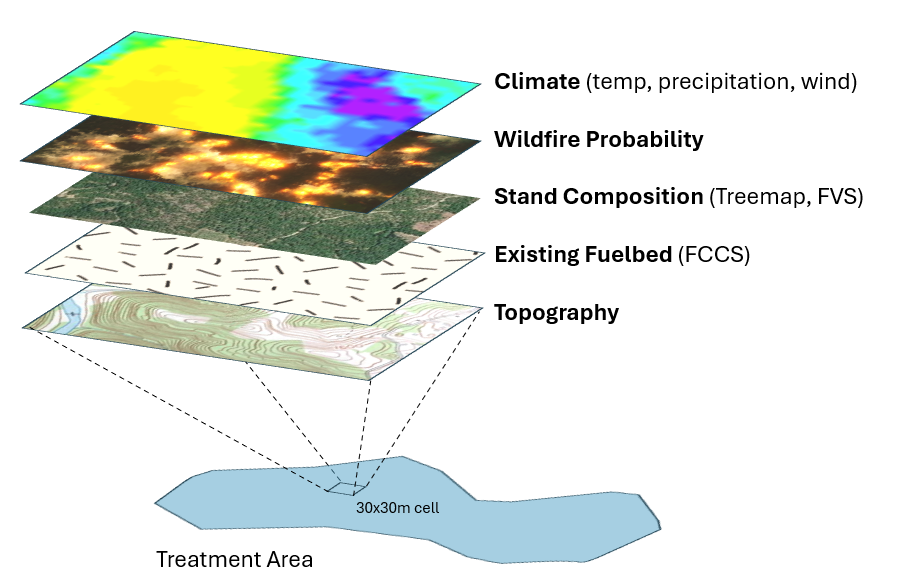
- The model uses spatial data (scaled to a 30mx30m statewide grid) to account for geographical variations in forest and climate conditions
- Emissions are estimated over a 100-year time series to allow flexible climate impact accounting
Input Data
The model relies on rasters of forest condition, climate, and wildfire inputs. The diagram below summarizes important features of the data that feed the workflow.
Model Workflow
- User defines treatment area by drawing a polygon on the map, over which a uniform treatment will be modeled.
- Forest state, climate, wildfire probability data is extracted for the treatment area
- Stand composition is used to estimate the amount of debris generated through treatment. Forest state is a derivitave of TREEMAP data, grown forward with FVS. Areas impacted by recent fires or treatments (post 2022) are not accurately reflected in the data, so use discretion in choosing an area to model.
- Baseline forest residue amounts (pre-treatment) are extracted from FCCS
- Climate data is used to estimate decay rates and impacts to wildfire intensity
- Wildfire probabilities through the next 100 years are extrapolated from area estimates.
- User selects treatment scenarios from a set of simplified silviculatural management description to be applied over the treatment polygon
- The user can choose to apply the treatment to a forest grown forward to 2025 or 2030
- The set of simplified silvicultural treatments includes:
- Cut all trees (100% basal area reduction)
- Thin-from-below at 20, 40, 60 and 80% basal area reduction
- Thin-from-above at 20, 40, 60 and 80% basal area reduction
- Variable Intensity - Thin-from-below to 55% of maximum SDI (Zeide), shade tolerant species prioritized for removal
- Variable Intensity - Thin-from-below to 30% of maximum SDI (Zeide), shade tolerant species prioritized for removal
- Applying the chosen treatment to the selected area generates a list of trees to be cut.
- Residue estimates for each tree are derived from the modeled treatment by using the species specific National Scale Volume and Biomass model developed by the USFS.
- 85% of the 6"+ diameter biomass is assumed to be removed as merchantable lumber (15% assumed damaged or wrong length) and included in the residue
- All residue (slash) biomass masses (per location) are stored by size class
- User selects business-as-usual residue management (portion of residues left onsite, fraction of material piled, fate of residue if not utilized)
- If not utilized, what would be the fate of the biomass?
- User defines details about residue collection and end-use
- Emissions are calculated for management alternatives of biomass produced from treatment at the site
- Utilization emissions include collection and processing of the material, transportation and direct emissions from combustion or other processes
- Models biomass collection operations including equipment selection based on terrain, harvest volume, and collection method
- Averages emissions from different processing methods (chipping vs. grinding)
- Power plant
- Calculates emissions from transportation of biomass and equipment, for both on-road and off-road portions of transportation to nearby use facilities
- Models emissions from biomass combustion at power generation facilities
- Accounts for different power plant technologies and efficiencies
- Calculates electricity generation and cogeneration heat outputs
- Includes natural gas offset calculations for cogeneration applications
- Models storage pile decay emissions at power plant facilities
- Biochar production
- Models biochar production as an alternative biomass utilization pathway
- Calculates carbon balance for biochar production and application
- Accounts for emissions from biochar production processes
- Models long-term decay of biochar in soil and associated emissions
- Field emissions include emissions from probabilistic wildfire, decay, and any pile burns that are specified
- Implements advanced fire behavior and emissions modeling
- Models pile burns and wildfire scenarios
- Incorporates probabilistic wildfire occurrence based on historical data and future projections
- Calculates emissions from wildfire events and pile burns affecting the treatment area
- Models natural decay processes of forest residues over time, accounting for variations in decay rates based on climate and residue characteristics
- Accounts for char production and its long-term carbon sequestration
- Models wildfire generated mortality of existing stand
- Net emissions are calculated as the utilization and field emissions in the use case minus the field emisssions in the reference (non-use) case. Note that
- Emissions of greenhouse gases and air pollutants are tracked over a 100-year period (timing of emissions is retained).
- Climate impact metrics are calculated
- The 100-year profile of net greenhouse gas emissions are converted to 100-year global warming potential
- Results are compiled and presented to the user
For more detailed information about using the C-BREC tool, please refer to the frameework document or contact us at c.brec@humboldt.edu